In memory of Sue Stone
The Seeds of Hope Requiem was written by Penny Stone in memory of her amazing feminist mum, Sue Stone, and brings together the words of women from all over the world, spanning from 575 CE until the present day. The requiem is sung in 18 languages and combines a variety of community choir, semi-chorus and soloist acapella singing with cello, violin, percussion and French horn. There are also some singing-together choruses for the audience to join in with that will be taught at the beginning of the concert. There is space in this piece for singing and listening, for sadness and joy, and for connection as well as time spent with our own individual feelings.
People of all genders are welcome at both the workshops and the concerts.
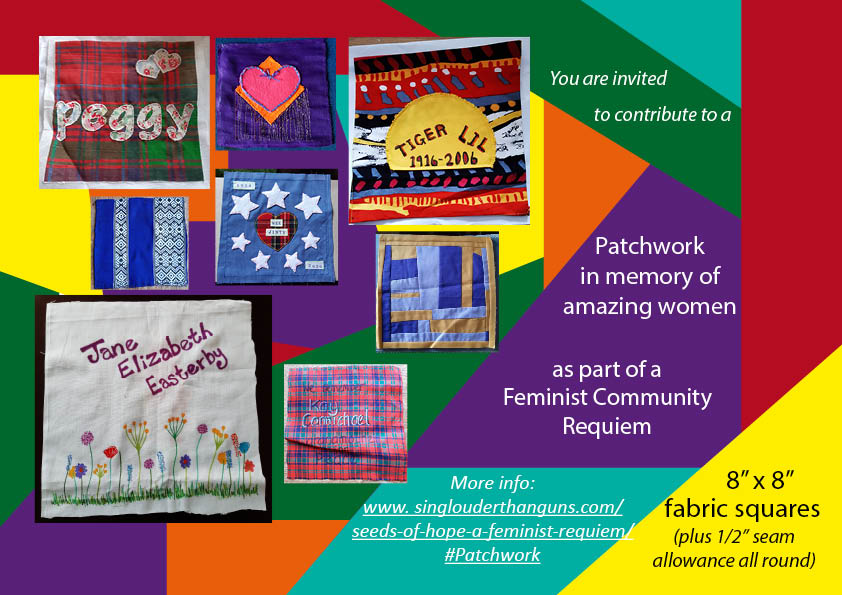
Since first premiering this piece, we have also made three patchwork panels remembering amazing women. Squares have been made by many different people to remember the women they love, and those who have been important in our lives whether we knew them or not. We are now collecting for a fourth panel, and if you would like to make a patch remembering someone you will find all the details here: https://singlouderthanguns.com/seeds-of-hope-a-feminist-requiem-patchwork/
You can read more about the requiem here: FAQs
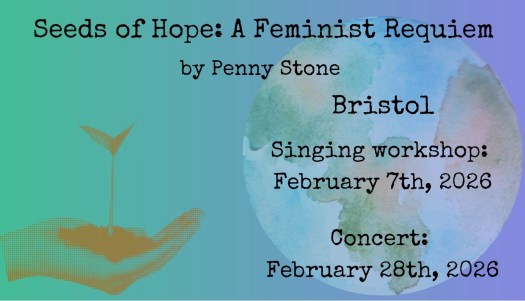
And there is a flyer for the Bristol event here.
Next performance: Saturday February 28th, 2026, St. Ambrose, Bristol
Booking info:
Further information and booking link for Workshop and/or Community Chorus
Further information and booking info for concert.
Upcoming Performances
Saturday February 28th 2026, St. Ambrose, Bristol
Saturday 3rd October 2026, Glasgow or Edinburgh, Venue TBC
Previous Performances
Sunday September 11th, 2022, Reid Memorial Church, Edinburgh
Saturday March 4th, 2023, Derby Cathedral
Saturday September 13th, 2025, St. Mark’s Church, Sheffield
FAQs
What is a Requiem?
The musical form of ‘Requiem’ has its roots in the Catholic Requiem Mass, a service to send a person who has died on their way. Many of the great musical requiems use the Latin mass texts as their basis, but during the last century the musical form has become adopted and adapted to have meaning beyond this one belief system. At their core, all requiems in some way remember the dead and give comfort to those still living. Many include the presumption of an afterlife, but not all.
What is a Feminist Requiem?
When my mum died, I knew that I would write a requiem for her. She deserved to be remembered by something really special, as well as by the many people whose lives she touched. But as time went on, it didn’t quite feel right. I studied the forms of musical and religious requiems and looked at how a requiem might make space for people who believe in God(s) and those who believe in other things. But to really honour who my mum was, I realised the requiem had to be truly feminist. So I set about analysing what that might look like, and it became clear that the requiem would need to include the voices of women throughout history and across the world. For me, as it was for my mum, feminism is about uplifting the voices of those who we don’t hear from often enough. In many ways it is about listening.
This requiem is about giving us space (and permission) to grieve individually and collectively. In Scotland and in England we aren’t good at speaking about death. We will all die, and we all will lose people close to us. So having more space to grieve in a community space, especially as we come out of the pandemic, seems to me a useful offering.
The music is written to hold us, to surround and soothe us, giving a safe space to feel our individual feelings, together.
Is it religious?
No. This requiem is a broadly secular requiem that I hope has space to hold whatever spiritual space people inhabit, regardless of belief.
Who is it for?
Anyone. We have all lost people who we have loved. Grief is like a loose thread on a woolly jumper – when we start to pull on it we realise it’s all connected to the next one. No-one is grieving for just one person, but for a web of people and shared experiences, good and bad.
What will happen at the concert?
There will be a mixture of soloist and choral pieces to listen to, and a few wee bits that you can join in with if you’d like to. In the middle there will be space to light a candle to remember someone as reflective singing is happening.
What if I cry?
We all need to cry. It’s a good thing to allow yourself to do.
Why community voices?
Over the 10 years I’ve been sporadically working on this piece, I spent some time writing beautiful and complex music. And whilst there is a great pleasure in that, I came to the conclusion that what would make this piece most feminist is if the music was truly accessible, and so there are many parts that anyone could sing. So much of it is sort of built of lego-like blocks, short repeated harmonic motifs that connect together.
Can I hear it?
The next performance will be in Bristol on February 28th 2026, with another one in Scotland, probably Glasgow, on October 3rd 2026. We haven’t made any recordings yet, but are planning to record a few excerpts to share in the summer of 2026. You can hear a two minute taster here:
Can I still contribute to the Patchwork?
Yes. We have had over 160 patches sent in, remembering many wonderful women, and these have been made into panels that will be the backdrop of the concert. However, at the workshops and concerts we will have a cloth and safety pins available so that anyone who wants to add a patch can do so, and when we have enough for a row or a new panel we will sew them together.
Whose voices are included in the requiem?
Writers & poets:
Al-Khansa, c. 575 , Arabian Peninsular
Hildegard von Bingen, 1098-1179, Germany
Lalleshwari (Lal Ded) 1320-1392, Kashmir
Julian of Norwich, b. 1342, England
Dorothy Wordsworth, 1771-1855, Cumbria
Virginia Woolf, 1882-1941, England
Josephine Baker, 1906-1975, Missouri & Paris
Frida Kahlo, 1907-1954, Mexico
Maya Angelou, 1928-2014, USA
Ingibjörg Haraldsdóttir, 1942-2016, Iceland
Sue Stone, 1947-2012, Cumbria & Derbyshire
Kathy Galloway, 1952, Glasgow
Lily Greenan, 1959, Edinburgh
Linguists, translators and lyrical collaborators:
Syeda Sadaf Anwar, Urdu
Margaret Bennett, Gaelic
Minaxi Champaneri, Hindi and Kashmiri
Alvina Chibhamu, Shona
Jamie Dawes-Hughes, Welsh
Kristín Eiríksdóttir, Icelandic
Hala George, Arabic
Guðrún Jónsdóttir, Icelandic
Eileen Karmy, Spanish
Sylvia Kralova, Slovak
Simone Lamont-Black, German
Nana Mzhavanadze, Georgian
Boatema Ofori-Frimpong, Twi
Jane Palfrey, Latin
Francoise Pinteaux-Jones, French
Elsebeth Sylvest Lassen, Danish
Wise Women Requiem – A Patchwork
All the information and pictures of the 3 patchwork panels so far can be seen here.
 Penny Stone